
DMA Evaluate lets you create a new version of a Double Materiality analysis and reassess your IROs year on year, without starting from scratch. Carried-over IROs keep their scores and rationale, so you only reassess what has changed.
Creating a new DMA version
- Go to your latest assessment.
- Click the three-dot icon and select Create new version. You are taken to the Settings page for the new version.
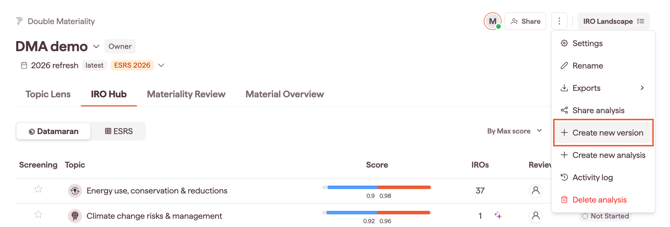
Note: you can only create a new version when all IRO assessments in the current version are complete. If at least one IRO is still In progress (has assigned reviewers), Create new version is disabled. This gating uses the Review status from the SME workflow, not the Assessment status field.
1. Name your new version
Enter a name that distinguishes it from previous versions.
2. Choose your carry-over options
Decide which IROs to carry over from the previous version:
- AI-generated IROs
- Custom IROs (created via import template or added manually)
- Both AI-generated and custom IROs (including IROs created via IRO Industry Landscape)
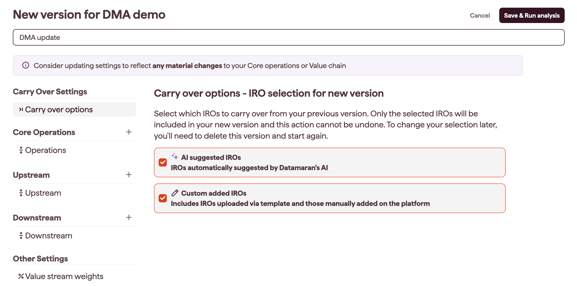
What happens when IROs are carried over:
- Carried-over IROs keep their previous scores and rationale, so you do not re-enter them for unchanged IROs. This includes IROs with active evaluation signals.
- Each topic's materiality path carries over too. A topic concluded top-down keeps its top-down conclusion, and a bottom-up topic stays bottom-up.
- Score history stays available in the audit trail and history panel, for traceability across versions.
- Each carried-over IRO is given an Assessment status to help plan the reassessment:
- bottom-up IROs flagged with a short-term signal are set to To assess
- all other carried-over IROs are set to Not required
Owners can change this status after the new version is created. Any IRO added later, manually, via import, or from a suggestion, defaults to To assess.
3. Update your assessment
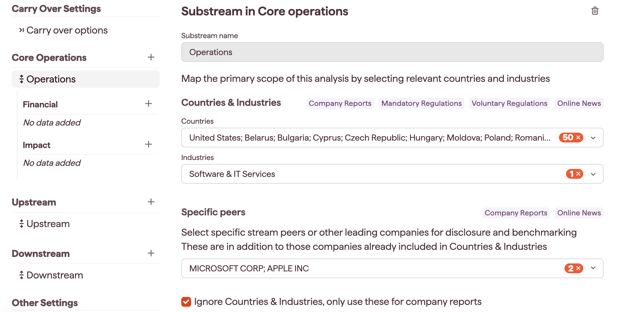
Review and update your settings to reflect any changes in your organisation or value chain for the new period.
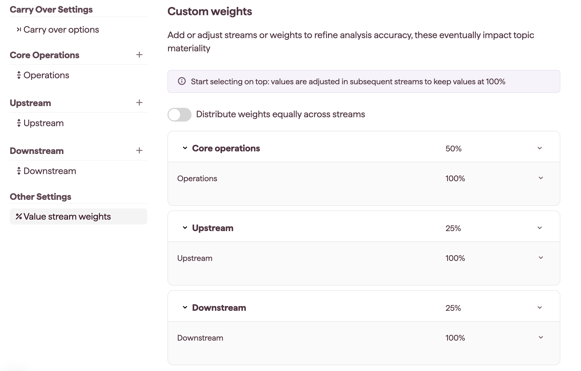
By default, the stream weights match your initial version. You can adjust them as needed.
4. Save and run
Click Save and run analysis to generate updated topic scores. These reflect your latest inputs and the most current data on the Datamaran platform.
Reviewing and reassessing IROs
Once the new version is ready, use the Assessment status column and the overview filters in the IRO long list to see what needs attention:
- IROs set to To assess on carry-over, or added since, are the ones to work through first.
- IROs set to Not required can be left as they are, or moved back to To assess if something has changed.
- Mark an IRO as Assessment complete once you have validated the reassessment.
Topics you keep on the top-down path should be re-confirmed at topic level. They do not go through the per-IRO reassessment or the threshold step. See Choosing a topic's materiality path: top-down or bottom-up.
For the full reassessment workflow, see Recommended evaluation flow for reassessing IROs. For scoring criteria, see Assessing IROs and their criteria.