
ESRS 2026 is the revised version of the European Sustainability Reporting Standards (ESRS), approved by the European Commission in July 2026 as part of the Omnibus simplification. From 30 September 2026, new Double Materiality analysis versions you create in Datamaran use the ESRS 2026 list of topics. Your existing work does not change.
The revised standard reduces the ESRS topic structure from three levels to two (topics and sub-topics), and some sub-topics were renamed, merged or split. For example, Waste (under E5 Resource use and circular economy) is now Resource outflows related to waste. The name changed, the meaning did not.
Why this matters
- Your completed assessments stay exactly as they were built, so your audit trail is protected
- You can finish an assessment already in progress without changes mid-way
- You decide when to move to ESRS 2026, by creating a new analysis version
How the rollout works
Each analysis version is linked to the standard it was created under. This link never changes.
- Analysis versions created before 30 September 2026 use ESRS 2023.
- Analysis versions created from 30 September 2026 use ESRS 2026, including AI-suggested IROs (impacts, risks and opportunities), the IRO Hub, the IRO industry landscape and the IRO upload templates.
Note: the platform doesn't currently show which standard a version uses. Use the date the version was created as your guide.
Your options
Your analysis is completed
No action is needed. It stays on ESRS 2023, including topics, IRO descriptions and scores.
Your analysis is in progress
No action is needed. You can finish it using the ESRS 2023 topics, without any changes mid-way.
You are starting a new assessment cycle
Create a new analysis version and carry your IROs forward. Once you confirm, they are re-tagged to ESRS 2026 automatically.
How to move your analysis to ESRS 2026
An existing analysis version can't be converted to ESRS 2026. To move onto the new standard, create a new version and carry your IROs forward into it. For the full version setup, see Updating your Assessment with DMA Evaluate.
- Open your Double Materiality analysis and create a new version
- In the carry-over options step, select the IROs you want to carry forward.
- Read the warning that appears. It confirms that the carried IROs will be re-tagged to ESRS 2026. Nothing changes until you confirm.
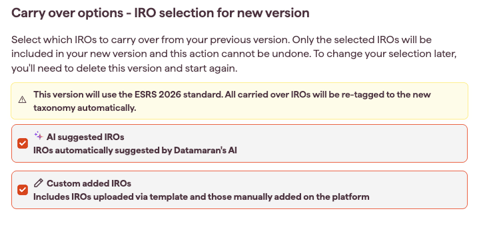
- Click Save and run analysis.
Note: your earlier version is not affected. It stays on ESRS 2023 and you can still open it.
What happens after saving
- Your IRO descriptions stay exactly as you wrote them, and only the ESRS topic and sub-topic tags are updated
- Most IROs move one-to-one to their ESRS 2026 sub-topic
- A small number of ESRS 2023 sub-topics were split or removed (mainly under Own workforce, Workers in the value chain, Marine resources, and Pollution of living organisms and food resources). For these, the platform automatically assigns the closest ESRS 2026 sub-topic
Tip: check the IROs under these sub-topics after carrying them forward. You can change any tag manually, see Mapping IROs to ESRS topics.
Notes on how this feature is designed
- Nothing is converted in place, so the work you have already shared with your auditors is never rewritten.
- Peer CSRD report data used for benchmarking will be shown using the same ESRS version you use in your current version, so every company is compared against the same standard.
- Carried IROs are re-tagged with a fixed mapping that links each ESRS 2023 sub-topic to its ESRS 2026 successor. Where an IRO has ESRS 2023 sub-sub-topic tags, these decide which new sub-topic it moves to.
- Datamaran keeps a record of every re-tagging decision. If you or your auditor need to know why an IRO moved, contact your Customer Enablement Manager.