
Entity fields are the attributes Datamaran holds about each organisational unit. The Applicability Assessment reads them to decide whether a regulation is likely to apply, so what you put here shapes what you get back.
Why this matters
- Understand which field drives which kind of regulatory trigger
- Know what "good enough" looks like before running an assessment
- Ensure you fill the fields that matter most
Core fields
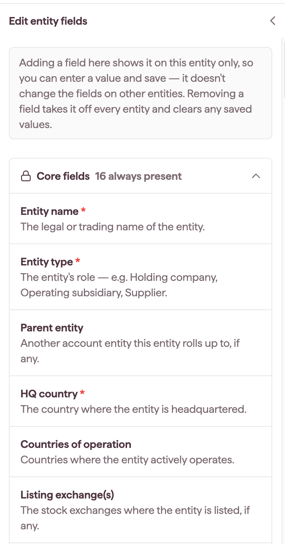
Every entity carries the same set of core fields. These are always present.
- Entity name. The organizational unit's name. Must be unique within your account, and used to match the entity against Datamaran's company data.
- Entity type. One of Holding company, Operating subsidiary, Special purpose vehicle (SPV), Joint venture, Branch & regional entity, Peer, Supplier, Customer or Other. Describes what kind of unit this is.
- Parent entity. Another entity this entity rolls up to, if any.
- HQ country. Where the entity is headquartered. Drives jurisdiction-based triggers, and determines which national rules are considered in the first place.
- Countries of operation. Every country the entity operates in. Drives jurisdiction triggers beyond the headquarters country: a regulation can apply where you operate even when it does not apply where you are registered.
- Listing exchange(s). The exchanges the entity is listed on, if any. Drives listing-based disclosure obligations.
- Primary Industry. The entity's primary SASB sector and industry. Drives sector-specific rules.
- Secondary Industry. The entity's secondaries SASB sectors and industries.
- Business activities. NACE Rev.2 activities the entity carries out, at any level of the hierarchy.
- Employee count. Headcount. Drives size-based thresholds alongside revenue.
- Annual revenue. Annual revenue in its reporting currency. Drives size-based thresholds.
- Products/Services. Key products and services the entity offers. Drives product and substance-based triggers, for example packaging, batteries, or chemicals rules.
Datamaran pre-fills what it can from public company data, and coverage is uneven. Treat a blank as normal and a pre-filled value as a starting point.
Note: select Countries of operation and HQ country from the country list or typing free text.
Identifiers
- LEI. 20-character Legal Entity Identifier, used to match the entity against company data.
- ISIN. 12-character ISIN, used to match listed entities.
US state-level detail
US entities carry one extra field.
- US States of operation. Every US state the entity operates in. Countries of operation tells the assessment the entity is in the United States, but not where. This field fills that gap, so state-level regulations can be checked alongside federal ones.
Which fields matter most
If you are filling entities in priority order, start here:
- HQ country and Countries of operation. Without these, jurisdiction-based rules cannot be evaluated at all.
- Revenue and Employee count. These decide most size thresholds. An entity missing both cannot be tested against a threshold.
- Primary Industry and Secondary Industries. Determine which sector-specific rules are in scope.
- Products/Services. Determines product and substance triggers. Be specific: "lithium-ion battery cells" is more useful than "manufacturing".
Those four are the recommended set. See Preparing your Company Profile for an Applicability Assessment.
After them, Products/Services drives product and substance triggers. Be specific: "lithium-ion battery cells" is more useful than "manufacturing".
Additional fields
Beyond the standard set, up to 38 additional fields are available for context the Applicability Assessment needs. Where a regulation's check requires data that your profile does not hold, the system flags the missing data and the required fields. See Adding custom fields to an entity.