
Target statements are summaries that Datamaran produces from the published targets it finds in a company's reports. Each statement is built from one or more underlying report mentions, all drawn directly from the source text.
This article explains how those statements are produced, so you can understand why a single target statement may be backed by several report mentions, and why the underlying quotes do not always match the statement word for word.
Why this matters
- Understand where the targets in your benchmark come from
- See why one target statement can be supported by more than one report mention
- Know that every statement stays grounded in the company's own reported text
- Read the benchmark results with confidence in how the figures are built
How targets are extracted from reports
Datamaran reads each company's sustainability, financial, or 10-K report and identifies the targets within it through the following steps:
- The report is converted into structured text. This represents tables and figures far more accurately than plain text.
- The text is split into chunks that hold together as a unit of meaning, such as a paragraph or a table.
- Each chunk passes through a first classification model, which sets aside chunks that are very unlikely to contain a target.
- The remaining chunks go to a larger model, which determines whether they contain ESG targets. For each target it finds, it extracts the metric, the timeline and the report year. These are the report mentions you see in the side modal.
- Mentions that refer to past targets are discarded. For example, a target for 2023 found in a report published in 2025 is left out.
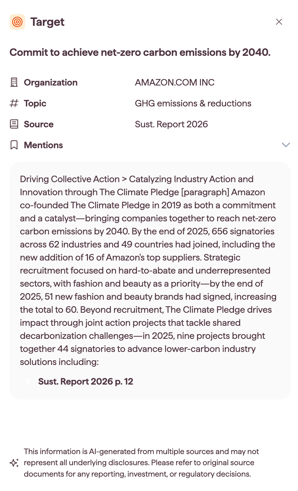
How mentions are grouped into a target statement
Once the mentions for a company have been extracted, Datamaran groups together the ones that describe the same target, then produces a single target statement for each group.
Mentions are grouped based on how similar their KPI is, alongside their timeline and value:
- when the KPI is very similar and the timeline and value are compatible, the mentions are grouped together
- when the KPI is less similar, the mentions are grouped only if their timeline and value match exactly
Each group is then summarised into one target statement by a large language model (LLM). That summary is what you see in the main benchmark view.
Note: Because a target statement summarises a group of mentions, the wording of the statement may differ from any single mention. Every statement remains based entirely on the information found in the company's reported text.
Why this approach
Grouping mentions into a summarised target statement gives you a clearer, more readable view of each company's targets, while keeping every statement grounded in the source reports.