
In the Double Materiality module, you can export all your IROs to an Excel file: the IRO export. It holds the final conclusion for every IRO, including the materiality path of its topic and the rationale. It's the main file you'll use to build your materiality determination log for auditors.
How to export your IROs
There are two ways to get the IRO export. Both download the same file.
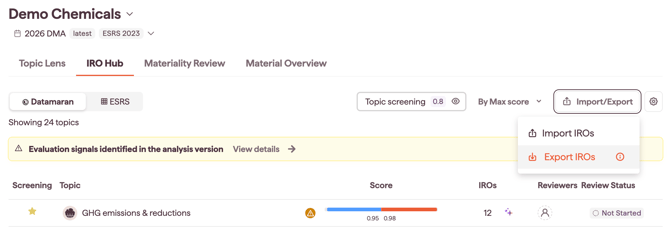
From the IRO Hub
- Click the Import/Export icon on the right side of the IRO Hub.
- Select Export IROs from the dropdown.
- The download begins automatically.
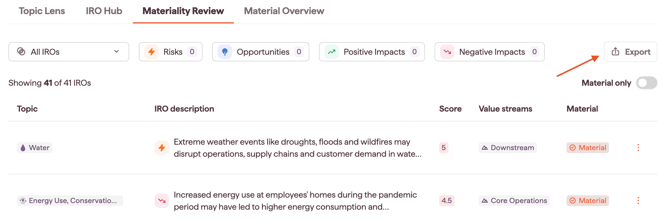
From the Materiality Review tab
- Click the Export icon on the right side of the tab.
- The download begins automatically.
What the export includes
The export includes all IROs, whatever their source: AI-generated, imported or added manually. What appears for each IRO depends on what exists for it in the IRO Hub.
For each IRO, you'll find:
- Determination pathway: whether its topic was concluded top-down or bottom-up. This is the Materiality path you set in the topic side panel.
- Determination rationale: the rationale you entered for a top-down topic.
- Materiality: a Yes or No value. Undecided IROs are included.
- Materiality Overridden and Materiality override rationale: whether the IRO's materiality was changed with the materiality override, and why.
- Custom fields you've added.
- Final IRO scores, in the Current Score tab.
- SME assessments, in the All Assessments tab: submitted scores, or the IRO descriptions with their topics.
- Reviewer aggregated data, only for IROs linked to topics marked Done.
What the IRO export doesn't include
- Who set each topic's materiality path, and when. These actions are recorded in the Activity log (see below).
- Topics with no IROs. The export has one row per IRO, so a topic concluded top-down with no linked IROs doesn't appear. You'll find it in the Activity log.
- Topic screening scores (impact and financial). These are in the Topic Scoring Export: click the three-dot menu and choose Exports > Topic Scoring Export. See Topic screening.
- The Assessment status (review process) column.
Building your materiality determination log
Auditors will ask for a materiality determination log: one line per included topic, with its materiality path, screening scores, rationale, who decided and when. It's Appendix C of the Double materiality process documentation template in your audit pack.
There's no single export with this record. You build it from three files, which saves you keeping it by hand all year:
| Column in the log | Where to find it |
|---|---|
| Topic, Materiality path, Rationale | IRO export: Determination pathway and Determination rationale columns (one line per topic) |
| Screening scores (impact and financial) | Topic Scoring Export |
| Determined by, Date | Activity log export |
| Top-down topics with no linked IROs | Activity log export |
- Download the IRO export and keep one line per topic.
- Add the impact and financial screening scores from the Topic Scoring Export.
- Download the Activity log. In the Excel file, filter on the action Update and the type Materiality path. For each topic, the latest entry shows who set its path and when. Paths carried over from a previous version keep their original entry.
- In the same filtered list, look for topics concluded top-down that have no IROs (they have their own entry), and add them to the log.
Note: Top-down topics still need underlying IROs for disclosure. Adding them in the IRO Hub before you build the log also brings these topics into the IRO export.
Who made the call and when: the Activity log
The IRO export shows the final conclusion. The Activity log shows each individual action that led to it. It lists every change made in a Double Materiality analysis, with the previous and new value, who made the change and when. That's why it's the source for the Determined by and Date columns of your log: the full history of each materiality path decision is recorded there.
To download it:
- In the Double Materiality module, click the three-dot menu next to the analysis and select Activity log.
- Click the download icon at the top right of the side panel.
The Activity log covers the whole analysis, including all its versions. You can only make changes in the latest version: older versions are locked when you create a new one.
The full log downloads as an Excel file. The download always includes every entry, whatever filters you apply in the side panel, so filter the Excel file itself on the action Update and the type Materiality path.
To check a topic's path history without downloading, use the filters at the top of the side panel: All actions › Update, and All types › Materiality path.
Note: The Activity log records changes made from October 2026. If you set a materiality path before that date, record who decided and when in your log yourself (your governance process mapping names the owner and approver for each decision).
More details: Activity log in a Double Materiality analysis