
Custom IROs let you add your own Impacts, Risks and Opportunities to the IRO Hub, so your analysis reflects the risks and opportunities specific to your organisation that the existing IRO inventory may not capture.
Custom IROs are fully integrated: you can assess, manage and export them alongside all other IROs in the Hub.
Why this matters
- Captures organisation-specific IROs that the standard inventory may miss
- Works the same whether you start from the Datamaran Topics view or the ESRS view
- Lets you assess, manage and export custom IROs alongside every other IRO
Creating a new custom IRO
The process is the same whether you begin in the Datamaran topic view or the ESRS topic view.
Step-by-step
- Go to the IRO Hub from the main navigation menu.
- Choose either the Datamaran Topics tab or the ESRS tab.
- Click a Topic Name to open the IRO list.
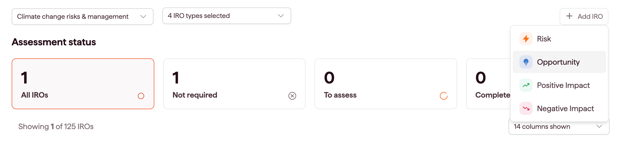
- Click Add IRO.
- Select the IRO type: Risk, Opportunity, Positive Impact, or Negative Impact.
- Fill in the IRO details:
- IRO description (required)
- Value stream (required)
- Datamaran topic, or ESRS topic and sub-topic (required)
- Review the criteria. The assessment criteria fields adjust to the IRO type. Fill in the relevant scores.
- Click Add IRO to save. The custom IRO appears alongside your existing IROs when the matching filters are applied.
Note: if you start from the ESRS view, the IRO is automatically mapped to the corresponding Datamaran topic, so you can view it in both taxonomies. You can change the Datamaran topic if needed.
Managing, editing and deleting custom IROs
Once created, you can edit or delete a custom IRO at any time, and update its assignment to a Datamaran or ESRS topic.
Bulk management using the IRO long list
The most efficient way to manage or delete a large number of IROs is through the IRO long list. From there, you can perform bulk actions, such as assigning reviewers or deleting multiple IROs at once.
Note: a custom IRO follows its topic's materiality path. In a bottom-up topic it is assessed like any other IRO; in a topic concluded top-down it inherits the topic-level conclusion, unless you route it for individual assessment. See Choosing a topic's materiality path: top-down or bottom-up.